OS 筆記 - Ch8 Memory Management
Ch8 Memory Management 的整理筆記
- Background
- Swapping
- Contiguous Allocation
- Paging
- Segmentation
- Segmentation with Paging
Background
- 所有東西都在 memory 裡面,即使有 cache 也都是暫時的
- memory management 要坐到保護,以及支援 Multiple programs,甚至跨到 Disk
How to "refer" memory in a program
- 這三個看圖就好 ...
- Compile Time : Compile 時間
- Load Time : Load 到 Memory 時間
- Execution Time : 執行時間
- Dynamic Loading, Dynamic Linking 也在這
- Address binding 在這三個都可能發生

- Address Binding : 程式將來要在 Memory 的那個 address 執行。
- 在 Compile Time 決定
- 由 Compile 決定 Physical address 在哪裡
- Memory 想要搬動程式 → 就完ㄌ,要 Recompile
- 為何要搬來搬去 ? Run time 才知道要跳到哪,以及 swap in 的時候原本位置可能被別人佔住了
- 在 Load Time 決定 ( Linking Loader 做 Binding )
- 用 Base Reg 做相對對址 (起始位置),
- 真正的 addr 就是 Base + 相對位址
- Load 時重新決定 ? OK ! 免 Recompile
- Run Time 重新決定 ? GG !
- 需要 Reload the code
- 其中有分 Relocation 修正和 Linking 修正
- Relocation 修正 : 修改 Base Reg
- Linking 修正 : 有些副程式或者 Library 的 memory segment 可能是分開的
對於此,如果有移動的話就會由 Linking Loader 修正
- 用 Base Reg 做相對對址 (起始位置),
- 在 Execution Time 決定
- 完全都是相對位置
- 使用 logical-address (virtual-address) -> 但是要 MMU 支援,Hardware Support
- MMU 就是一個硬體,後面會簡單介紹
- 現在基本上都這樣做
- 在 Compile Time 決定
- Logical vs. Physical Address
- Logical address 就是 "虛擬位址",又稱 Virtual address。
程式雖然指定了要去讀某個地方,但實際上是被 OS 騙的,不會真的去讀那個地方。
當然,相對的,OS 也會給他相對應的資料讓他正常運作,
一切都是為了更好的去做記憶體管理。為了蔚藍清淨世界 (青き清浄なる世界のために ) - 如果是 Compile-time & Load-time Address binding
- logical addr = physical addr
- Execution-time address binding 的話當然就不是
- Logical address 就是 "虛擬位址",又稱 Virtual address。
How to "load" a program into memory ?
- Dynamic Loading
- 整個 Program 不一定全部都會用到,全部 Loading 很浪費
- 像是很多 debug 用的 error handling code 就不是一定用到
- 所以做成 Dynamic Loading
- A routine is loaded into memory when it called
- 並不是 OS 幫你決定哪些是 Dynamic Loading 的 function call
- 是使用者自己決定的 !
- ex : C語言中使用
<dlfcn.h>
- 整個 Program 不一定全部都會用到,全部 Loading 很浪費

Static Linking
- libraries are combined by the loader into the program in memory image
- 你 C程式 Compile 完就會把所有 Lib Link 到程式中
這是沒辦法的,不然沒辦法執行阿,一定要有那些 Lib
- 你 C程式 Compile 完就會把所有 Lib Link 到程式中
- Static linking + Dynamic loading
- 無法避免還是要 duplicated code
- libraries are combined by the loader into the program in memory image
Dynamic Linking
- 新的解決方式 !
- Lib 定義也不會改 系統存一份就好
- Run Time 再去找
- 像是 DLL 檔案 in Windows
- Compile 時要告訴 Linker 下個 flag 說要用 static 還是 dynamic
- Dynamic Library 可以用在兩種 Linking 上,Static Library 就只能 Static
Memory-Management Unit
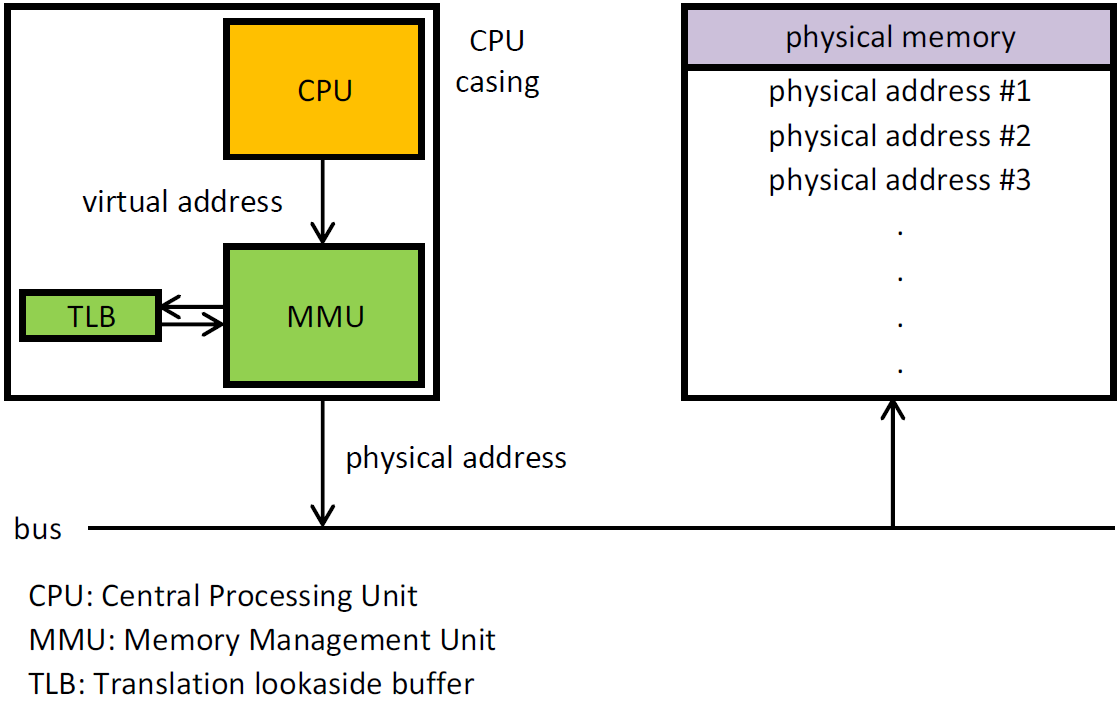
- Hardware device that maps virtual to physical address
實際上的功用就是負責把 Logical address 轉成 Physical address。
是一個 Hardware。 - 以前的 MMU 可能是負責做在主機板上,不過現在嘛,CPU 已經算是一個大單元了
廠商可能直接把 MMU 整合在 CPU 裡面,但實際上細分的話邏輯運算單元跟 MMU 還是分開的。 - TLB 是 MMU 的好朋友。就像這張圖一樣。
- TLB 後面會介紹,簡單來說就像是 MMU 的 Cache。
Swap
- Backing store : 就一塊空間 (a chunk of disk),跟 File system 是分開的
- 跟 Binding Address 關聯 :
- 如果你在 Compile / Load Time 就 Binding :
- 你一定要 Swap 回相同位置不然會出問題
- 如果你在 Execution Time (用 Base Reg 等的) :
- OK !
- 如果你在 Compile / Load Time 就 Binding :
- A process to be swapped == must be idle
- 也就是不能在做 I/O。雖然在 waiting queue,但他在做 I/O,如果做 Swaping ... 就會寫錯。
- 如果他是在 Sleeping waiting queue 就沒問題
- Solution :
- 做完 I/O 再 Swap
- 要搬的那些先由 OS Buffer 代管
- 搬誰,很重要 : 如果剛搬過去,OS 又需要他了,尷尬 (CH9 Algo)
Contiguous Memory Allocation
- Fixed-partition allocation :
- 停車場,每個停車格都一樣
- degree of multi-programming 很好管理
- 問題 : 路邊停車 有人一次得停很多格 亂停到別人那邊
- Variable-size partition :
- 很多洞可以找洞塞
- Dynamic Storage Allocation Problem
- First-fit : match 到的第一個
- Best-fit : 最佳 match 解
- Worst-fit : 最ㄎㄅ的,找最大的洞
- 我先用掉大的就會產生剩餘的小的,搞不好別人就剛好可以塞進來
- 比較 : First-fit 最快找到,另外兩個要 O(n) 全 parse
但是一定不可能會把記憶體剛好都弄滿,於是出現 Fragmentation 問題
Fragmentation
- External fragmentation
- 每個格子外,會有零碎的記憶體區塊
- Occur in variable-size allocation
- Internal fragmentation
- 每個格子內,會有零碎的記憶體區塊
- Occur in fixed-partition allocation
- 真要說,也是有解法 : **Compaction **(壓縮)
- 定期清理整理,壓縮
- 其實不會那麼常用,反正後面有 Paging 解法了 ...

Page
Page Concept
- 在 Physical Memory 切割 fixed-sized blocks,叫做 Frames
- 在 Logical address space 切割同大小 blocks ,叫做 Pages
- Keep track of free frames
Benifit :
- 可以不連續的使用記憶體
- shared memory : Share page 很方便做到
- Avoid external fragmentation,Limit internal fragmentation
Page Table
- 每個 Entry 都對應到 base address of a page in Physical Memory。
- 每個 Process 都有一個 Page Table
- Logical address 由 Page number 和 Page Offset 組成
- Page number 就是 page table 的 index
也就是說,假設這邊有 n bits,那這個程式最多只能用 2^n 個 page 組成
你用超過這麼多 page ... 會無法表示 - Page offset : 有時候只是要 page 裡面的某些片段,offset 可以拿來表示你要哪個 byte address
- Page number 就是 page table 的 index
![Logical address,長度 m]()
- 轉換過程 : 先查好 Page Number 對應到的 Frame Number
然後把原本 Logical address 的 Page number 的部份替換成 Frame number
就是 physical address。


- 會有 Free Frame List 來記錄,這樣我們需要的時候就能直接分配
相對的,Free 掉一個程式,就把他用的 Frame 加入這個 List 即可。 - Page / Frame Size : 通常都是 4KB 或 8KB。有點經驗法則。
- 如果太大 ? 那可能 internal fragmentation 會有點嚴重。
- 如果太小 ? 那我要花很多 entry 去紀錄,也就是 Page Table 會很大
而且程式會因此跳來跳去,要 access 很多,也要很頻繁從 Disk 抓
- 其實有 Frame table 的存在,只是 ... 基本上沒啥用
- 比較有用的也只有 invertible page table
- Implementation
- Page table 在 Memory
- Page table 有個 base register (PTBR) : 指到 Page table 的 實體位置 (physical memory address)
- 這東西在 PCB 會記錄起來 (用一個 reg 紀錄)
- Changing the value of PTBR during Context-switch
- 應該是指 PCB 裡面的內容需要替換,所以 PTBR 這格會被換成另一個 Process 的 PTBR
- 因為 PTBR 的存在,所以每次 memory reference 就需要 2 次的 memory reads
- " 2 次" 這個問題,我們使用 TLB ( Translation Look-aside Buffers ) 來做改善。
TLB
Associative Memory
- 也是個 Table,但是是很快的 memory。
- 他設計成 可以一次查詢所有 Entry,可以 O(1) 而非 O(n)
- 故,設計複雜,價格昂貴,不可能所有 page table 都塞進去
TLB 就像是 MMU 的 Cache
做 Context Switch 時,TLB 會被 flush。總不能混用別人的 Frame ...
- 或是也可能在 TLB 加一個欄位,寫 PID,但通常不會這樣做,不然又要再浪費空間,又要花時間比對
- Flush 之後 ... 恩,下個 process 上來其實也會瘋狂 miss (Table look up)
所以又要到填滿了之後才會有更好的效率

What is ASID ?
全名 Address Space ID,以下節錄一篇文章中的解釋還有可能進一步提升TLB的性能嗎?有沒有可能根本不flush TLB?
當然可以,不過這需要我們在設計TLB block的時候需要識別process specific的tlb entry,也就是說,TLB block需要感知到各個進程的地址空間。
為了完成這樣的設計,我們需要標識不同的address space,這裡有一個術語叫做ASID(address space ID)。原來TLB查找是通過虛擬地址VA來判斷是否TLB hit。
有了ASID的支持後,TLB hit的判斷標準修改為(虛擬地址+ASID),ASID是每一個進程分配一個,標識自己的進程地址空間。
TLB block如何知道一個tlb entry的ASID呢?
一般會來自CPU的系統寄存器(對於ARM64平台,它來自TTBRx_EL1寄存器),這樣在TLB block在緩存(VA-PA-Global flag)的同時,也就把當前的ASID緩存在了對應的TLB entry中,這樣一個TLB entry中包括了(VA-PA-Global flag-ASID)。
有了ASID的支持後,A進程切換到B進程再也不需要flush tlb了,因為A進程執行時候緩存在TLB中的殘留A地址空間相關的entry不會影響到B進程,雖然A和B可能有相同的VA,但是ASID保證了硬件可以區分A和B進程地址空間。
Effective Memory-Access Time
假設題目
- 20 ns for TLB Search
- 100 ns for memory access
- Effective Memory-Access Time (EMAT)
- 70% TLB hit-ratio :
EMAT = 0.70 x (20 + 100) + (1-0.70) * (20+100+100) = 150 ns - 98% TLB hit-ratio :
EMAT = 0.98 x 120 + 0.02 x 220 = 122 ns - 註 : (20+100+100) 是 兩次 Memory access (前面提的 PTBR),20 是 踩 TLB。
但是私自認為 20 應該不用算進去,如果說查 TLB 和 Page Table 是同時的話。
- 70% TLB hit-ratio :
Memory Protection
每個 Page Table 通常會再加一個 Protection bit,可以當作 valid,或者是 read write 等
不過一般都是當 valid-invalid bit
- 有可能你 malloc 先幫你開了,但你還沒用到,畢竟 Process 是會成長的
- 另外,Virtual Memory 章節 : 有可能他已經被 Swap out 了,所以不能用
- 或是 OS 動手腳,不給你權限
- 程式隨時在變,也有可能中間某個 page 突然不要了,直接標記 invalid
可能 Page Table 很大但後面都沒用到 ...
- Use page table length register (PTLR)
紀錄長度,方便檢測 - 另外這個 Length,有時候可能是 我們用到了 "第N個 Page的第80%"
單位是 byte,長度可以表示的更細
- Use page table length register (PTLR)
Shared Pages
- 對於一些 Pure code (Reentrant code)(Library 之類的),很好用
- Two (several) virtual addresses are mapped to one physical address

Page Table Memory Structure
有時候很難 allocate 一塊空間去放 Page Table
- 4G 的 Memory + 4KB 大的 Page
- 2^20 個 entry,每個 entry 4 bytes,4MB 的 Page Table !
- 但是我們不一定有這麼大的連續空間 ...
- 4G 的 Memory + 4KB 大的 Page
Solutions:
- Hierarchical Paging
- Hash Page Tables
- Inverted Page Table
Hierarchical Paging
- 我們乾脆把 Page Table 做 Page Table 吧。
- 舉例 : Two-Level Paging
- 下面這張圖,第一層有 2^10 個 Entry,每個 Entry 對應到一個 小 Page Table
- 每個 Page Table 大小當然也會跟著變小。
- 這樣我們就指要找到 2^10 個連續的 1KB 大小的記憶體就行了~
- 然而,這樣子做的目的在於 : 更好的分配記憶體空間。而非減少 Page Table 所佔用空間
- 缺點 : 3 次 Memory Access

- 是說,如果是 64 bits Address ?
- 假設 42(p1) + 10(p2) + 12(offset)
- 2^42 個 entry,2^42 * 4B(每個entry大小) = 16TB ...
- 所以即使你想要把 64 全部拿來做,你根本沒這麼大的記憶體
- 2^42 個 entry,2^42 * 4B(每個entry大小) = 16TB ...
- 換成 12 + 10 + 10 + 10 + 10 + 12 好了
- 2^12 * 4B = 16KB 的連續 Memory
- ... 問題是要 6 次 Memory Access,一般通常做到 4 就受不了了
- 假設 42(p1) + 10(p2) + 12(offset)
Hash Page Tables
- 把 Virtual page number 做 hash,變成 entry。重複的話跟 hash 一樣,直接串在 bucket 後面
- 經濟效益 :
- 不管 virtual address 空間,反正是 hash
- Page table 你可能剛好用 第一個 entry 和 最後一個 entry (有點極端),但你整張表還是要建;
hash table 的話,沒用到的就不存在於此 hash table 中。
真的很少的話,其實找 bucket 後面的 也不會到說很久
- 缺點 :
- Pointer 的浪費
- 走 Linked-List 有點浪費時間

- 改善 : 如果採這樣的改善方式,每次走一個 Node 就能直接掃多個 小 entry
不過實做上可能有些困難

Inverted Page Table
- 管理好多 Page Table 太麻煩,直接做個管理 Frame 的 Frame Table
- 每個 Entry (index) 就代表哪個 Frame,取而代之,那格裡面儲存的是 PID 和 Page Number。
- 優點 : 只要 allocate 一次,反正 Frame 的數量,Size 並不會變。
- virtual address bits 數量通常遠大於 physical address
他的 Size 跟 physical memory size 有關 所以表會小一些
- virtual address bits 數量通常遠大於 physical address
- 缺點 : 你要找超久,Worst case 要找整張 (也許能用 hash 解決一些)
主要問題是很難做 share memory

Segmentation
基礎概念
fixed-size 的概念
A program is a collection of segments
- main program segment
- function segment
- ... etc,可以個別去增長
external fragmentation 會比較嚴重
Logical address: (seg#, offset)
- offset has the SAME length as physical addr.
- 因為現在沒有 Page 大小限制了,可以無限增長,甚至整個 physical memory 大小都可能
- offset has the SAME length as physical addr.
Segmentation Table : maps two-dimensional physical addresses;
each table entry has :- Base (4 bytes): the start physical addr
- Limit (4 bytes): the length of the segment
- 長度任意,所以要有一個限制 (Compiler 或 OS 幫你決定)
Segment-table base register (STBR) :
- the physical addr of the segmentation table
你這個 Table 總也有個位置要記起來,讓 OS 可以查
- the physical addr of the segmentation table
Segment-table length register (STLR) :
- 因為這個 Table 可能放非常多 segment,所以也要紀錄一下長度(當然只要一個reg就好)

流程
- CPU 請求 logical address
- 查詢在 table 的哪個 entry
- 查詢 entry 內的 limit 欄位,看一下 logical address 的 offset 是否有超過。
- 超過代表非法存取,丟 trap (addressing error);
- Physical address cannot overlap between segments
- 沒超過則拿 segment base address 去組合成 真正的 physical address
→ 成功 access
Protection & Sharing
- Protection bits associated with segments
- 可以設定 Read-only segment code
- (code section)
- Read-write segments
- (data section, heap, stack)
- 可以設定 Read-only segment code
- Code sharing occurs at segment level
- 兩個程式,在 segment table 的某一 entry 都記錄同個 limit 和 base
- Shared memory communication
- Shared library
Segmentation with Paging
- 我覺得偏補充,如果是考試生,真的覺得不好懂的話就別搞懂了,幾乎沒考過
- 先把 Process 做 Segment,再把 Segment 做 Paging 的一個神奇轉換方式。
- 以下舉例, 部分使用 Intel Pentium Segmentation 實例做解釋
- 可以先看這張圖簡單理解一下,下面雖然分段解釋,但內容偏多,有點散。

第一段,CPU → Descriptor Table : Logical address
CPU 仍然請求他的 Logical address,這點並不變。- Logical address 的組成是 Selector + offset
- 這個 Logical address 的長度可能超過 32,舉例,Selector 16 bits,offset 32 bits
- Selector 的組成是
- Segment number (13 bit) + Table Indicator (1 bit) + Protection info (2 bit)
- Segment number 就像是 index 一樣的存在
- 所以,其實系統可以表示 2^13 個 segment。
加上 TI 的話,變成 14 bits,實際上可以表示 2^14 個,一半 share 一半不 share
- Table Indicator (TI) : 紀錄該用 GDT/LDT,0 就是 share,1 就是 private
- TI 為 0 時,會取用 GDT 中的 Segment descriptor
- GDT = Global descriptor table,shared segment
- GDT 的第 0 個位置實際上是不會被用到的,
故把 index 和 TI 都設 0 的話就是 Null Segment,去存他會被丟 exception
- TI 為 1 時,則會取用 LDT 中的 Segment descriptor
- LDT = Local descriptor table,private segment
- TI 為 0 時,會取用 GDT 中的 Segment descriptor
- Requested Privilege Level (RPL) : Protection info,表示 0~3,RWX (讀寫執行)
- Segment number (13 bit) + Table Indicator (1 bit) + Protection info (2 bit)
- Logical address 的組成是 Selector + offset

第二段,Selector 查出要找 share / 不 share 的 Descriptor Table ( GDT 或是 LDT),
然後根據 Segment number (index) 去找 Table,得知 Segment descriptor。
從這東西可以再提取出 Base address,把 Base address + offset 得到 Linear address (32bits)。簡單來說的話是上面這樣啦,實際上還有很多細節。以下順便說說
Segment Descriptor 是 8 bytes,對,不要懷疑
這是 Segment Descriptor 的結構,兩排,所以 8 bytes 沒錯。
![]()
Base Address 雖然分開三個地方放,但是組起來的話仍然是 32 bits,完美。
Offset 根據上一段所說明也是 32 bits,所以相加也是 32 bits,完美完美。
產出的東西我們叫他 Linear address,因為他什麼也不是,反正就是個中間值其餘欄位的介紹大概是這樣,看看就好。
![]()
我個人是把 Descriptor Table 想像成 Segment Table,只是記錄的東西有點不太一樣。
可以直接當作 Segment Table 裡面有個 Data Structure 反正會幫我們產 Base Addr 就行啦 !這中間有很多邊界問題,如何設計才能不讓程式隨意 access 其他區段,是 MMU 要去自行處理的
第三段,假設是 Two-Level Paging,就到我們熟悉的部分 ... 分段,查 Page Table
- 這邊說到,第一層的 Page Table (Outer page table) 可以拿來指到多種 Table。
你可以跟平常一樣,指到一個 小的第二層的 page table
(一個 2^10 entry 的 table,對到很多個大小為 4KB 的 Page)
也可以直接拿去指一塊 offset 很大的 Page- 想想,其實一個小 Page table 能表示的 Physical memory 就是 2^22,其實也剛好就是這塊 大 Page 的 4MB 大小。
- 當然,會有一個 bit 在第一層 Page Table 那邊。
![]()
- 這邊說到,第一層的 Page Table (Outer page table) 可以拿來指到多種 Table。
Example
- Physical Memory 512 B = 2^9 → 灰色部分 9 bits 合理 (灰色部分是 Segment offset);
Page Size 32B = 2^5 → offset 5bits (在 Liner 轉 Page 分割才要取)
8 Segments = 2^3 → 3 bits 在控制要到哪個 segment。 - 題目給 Logical address 448 (hex) = 010001001000 (binary)(前面自己補0)
- 010 = 2 (dec),找第二個 entry,得到 001110110 (Base address),和 001001000 (Segment offset) 相加,得到 010111110 (Linear address)。
- 010111110 (Linear address) 可以再根據 Page Size 的 offset 5bits 此資訊切割。
所以 Page number 是 5,查 Page Table 得 2,這樣 Physical address 就是 001011110
![]()
- Physical Memory 512 B = 2^9 → 灰色部分 9 bits 合理 (灰色部分是 Segment offset);


Review
P.17
- 3 types of address binding?
- compile-time
- 越簡單的越快,MMU 也要時間,簡單的 Device 可能會選擇這個
- load-time
- execution-time
- compile-time
- logical address? physical address ?
- virtual → physical mapping ?
- dynamic loading ? static loading ?
- dynamic linking ? static linking ?
P. 42
- memory frame? page? typical page size?
- page table? virtual → physical translation?
- What is PTBR register? When to update it?
- Memory reads # for each reference?
- HW support for paging speed?
- associative memory
- TLB
P.58
- memory protection by page table?
- valid, invalid bits?
- page table memory structure?
- hierarchical → 2-level, 3-level, etc
- hash table → linked list
- inverted page table
- How are pages shared by different processes?
P.75
Segmentation vs. Paging?
Paging Segmentation Length Fixed Varied Fragmentation Internal External Table Entry Page number -> Frame Number Seg ID → <base addr, limit length> View Physical memory User progam Paged segmentation ?
補充
![]()
- A page fault is signaled by hardware ! ( 洪 : 只要是 singal 87% 都是硬體造成 )
- The computer hardware traps to the kernel
- TLB Miss -> TLB exception -> can also page fault ( 非 result in )
- 當TLB是由軟體實作時, TLB miss會產生 "TLB exception" 給 OS,
然後OS會去處理之後的 page table access (by PTT leosnake,不確定正確性)
- 當TLB是由軟體實作時, TLB miss會產生 "TLB exception" 給 OS,
- TLB miss 是 OS 處理,Page fault 也是 OS 處理
如果非 MIPS 系統軟硬體都可以處理 (偵測時就都是硬體)
- A page fault is signaled by hardware ! ( 洪 : 只要是 singal 87% 都是硬體造成 )
- Page Fault 處理 流程
- Page Fault 是一種 exceptions,其中又是 Exceptions 的 Fault 類別
- swap out 不盡然是必要的!需視 victim page 是否曾被修改,利用 dirty bit 來判斷,節省不必要的 I/O 動作。

參考
Mage 大的筆記、周志遠教授 PPT 與影片、Segment with paging、Segment_descriptor wiki、MMU Wiki
END
-----------------------------------